In my husband’s law practice, I’ve encountered many people seeking to end their marriages. Some of them had bought into the popular myth that marriage is a 50/50 partnership. However, when couples buy into this belief and assess their marriages by a 50/50 standard or as an equal partnership, it leads to such things as disappointment, frustration, anger, and often, a battle about the 50/50 division of marital assets in a divorce.

I believe that one of the biggest threats to marriage in our society today is the transition from the values of collectivism to individualism. In a society that values collectivism, the focus is on group goals and what is best for relationships. In individualistic societies, the focus is on the goals and rights of the individual, the personal rewards and the benefits. These differing values reflect two types of marriages – those based on a contract and those based on a covenant.
Individualism creates a contractual attitude in the marriage relationship. When the relationship encounters any kind of challenge to their autonomy, or adversity, or if the relationship ceases to be perceived as personally fulfilling or beneficial, or when one spouse believes that they are contributing more than they are getting back, the relationship loses its value, and one or both spouses decide to dissolve the relationship. You could say that the contractual perception of marriage is based on personal selfishness with little regard for the other person in the relationship and their well-being. It is a conditional relationship.
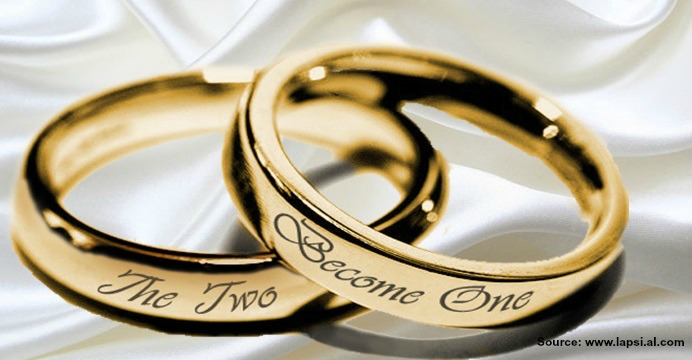
In a covenant marriage each spouse gives 100 percent of themselves. The 100 percent given by one spouse may look different than the 100 percent given by the other spouse, but neither spouse occupies themselves by keeping score. The priority in a covenant marriage is the well-being of the other spouse. The couple is more concerned with giving and serving, not with receiving. The couple who bases their marriage on a covenant willingly sacrifices for the other spouse. In addition, a covenant marriage is not considered a partnership, but a union. A partnership can break up or dissolve, but a union is like a merger, the two parts unite to become one new lasting entity.
The difference between contractual and covenant marriage was described by Elder Bruce C. Hafen, a religious leader for the Church of Jesus Christ of Latter-day Saints. In a talk titled “Covenant Marriage,” he taught:
“Marriage is by nature a covenant, not just a private contract one may cancel at will. Jesus taught about contractual attitudes when he described the “hireling,” who performs his conditional promise of care only when he receives something in return. When the hireling seeth the wolf coming, “he leaveth the sheep, and fleeth . . . because he . . . careth not for the sheep.” By contrast, the Savior said, “I am the good shepherd, … and I lay down my life for the sheep.” Many people today marry as hirelings. And when the wolf comes, they flee. This idea is wrong. It curses the earth, turning parents’ hearts away from their children and from each other” (1996, para. 3).
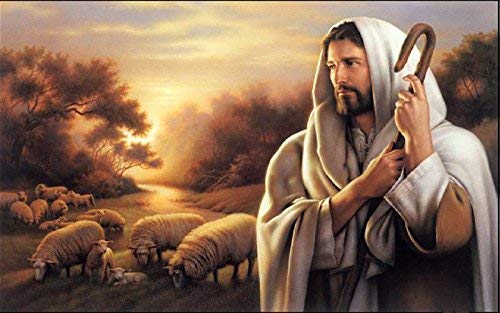
Relating this to marriage relationships, Elder Hafen stated,
“When troubles come, the parties to a contractual marriage seek happiness by walking away. They marry to obtain benefits and will stay only as long as they’re receiving what they bargained for. But when troubles come to a covenant marriage, the husband and wife work them through. They marry to give and grow, bound by covenants to each other, to the community, and to God. Contract companions give 50 percent; covenant companions each give 100 percent” (1996, para. 2).

Members of the Church of Jesus Christ of Latter-day Saints believe that “marriage between a man and a woman is ordained of God and that the family is central to the Creator’s plan for the eternal destiny of His children” (2006, Why Marriage is Essential, para. 1 ). Marriages performed in their temples are meant to be honored as covenant marriages, intended to unite the couple, not just for this life, but throughout all eternity. These marriages require more than just a man and a woman to create a successful union. Elder David Bednar, an apostle for the Church of Jesus Christ of Latter-day Saints taught how marriages become successful covenant marriages and the greatest source of happiness. He explained:

“The Lord Jesus Christ is the focal point in a covenant marriage relationship. Please notice how the Savior is positioned at the apex of this triangle, with a woman at the base of one corner and a man at the base of the other corner. Now consider what happens in the relationship between the man and the woman as they individually and steadily “come unto Christ” and strive to be “perfected in Him” (Moroni 10:32). Because of and through the Redeemer, the man and woman come closer together.”
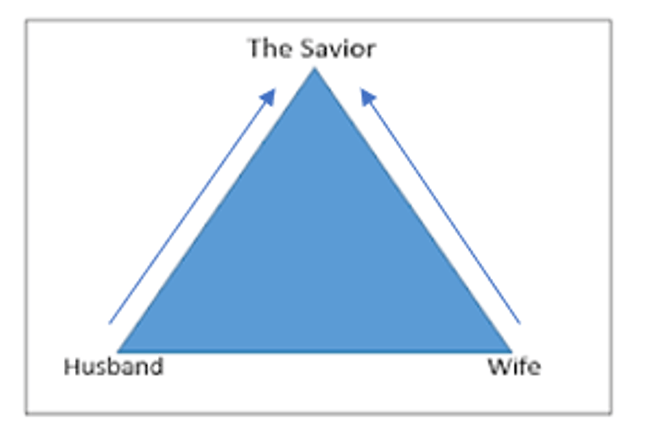
“As husband and wife are each drawn to the Lord, as they learn to serve and cherish one another, as they share life’s experiences and become one, and as they are blessed through the uniting of their distinctive natures, they begin to realize the fulfillment that our Heavenly Father desires for His children. Ultimate happiness, which is the very object of the Father’s plan, is received through the making and honoring of eternal marriage covenants” (2009, Principle 3, para 2-3).
This truth can best be illustrated through sharing a personal experience. My husband and I learned first-hand how including Christ in our covenant marriage relationship strengthens marriage when our 3 ½ year-old son was diagnosed with cancer. The hospital social worker told all the parents of the children receiving treatment that most of us would be divorced within a few years. Sadly, for some of the couples, that prediction was correct. But by drawing close to Christ and depending on one another, the experience drew us closer together and our marriage was strengthened, rather than destroyed. Instead of focusing on our own pain and our own needs, we focused on one another. We came out of the experience knowing that by honoring our marriage as a covenant relationship, together we can overcome all the trials that come our way.

Sources
Bednar, D.A. (2006, June). Marriage is essential to his eternal plan. Ensign. The Church of Jesus Christ of Latter-day Saints. https://www.google.com/url?q=https://www.churchofjesuschrist.org/study/liahona/2006/06/marriage-is-essential-to-his-eternal-plan?lang%3Deng&sa=D&ust=1580361766319000&usg=AFQjCNEnN_WOKQ6hYOOdyuSZx5fRE6vS3Q
Hafen, B.C. (1996, November). Covenant Marriage. Ensign. The Church of Jesus Christ of Latter-day Saints. https://www.google.com/url?q=https://www.churchofjesuschrist.org/study/general-conference/1996/10/covenant-marriage?lang%3Deng&sa=D&ust=1580361766319000&usg=AFQjCNE71CJlcsXr2t28U4bKWNC6fUYY6A
 Kirsten's marriage blog