In one of my lower level marriage classes, one of the activities I completed was interviewing an older couple who I knew to have a healthy and vibrant marriage. The husband was the bishop of the local congregation (known as a ward) of the Church of Jesus Christ of Latter-day Saints when we moved to the area during our first few years of marriage. In the capacity of bishop, he counseled many couples who were having marital issues. In the interview, when the topic of disagreements came up, he stated that “if [he] hears that a couple has gone through their marriage without a cross word, [he thinks] ‘What a boring marriage!’ “ He continued to explain that “couples are going to disagree, and if they’re not disagreeing, one or the other of them is not getting a fair shake, or the chance to say what they think. . . . Too many couples today will keep taking [the disagreement] farther and farther until it drives them apart – to deciding this isn’t going to work out and they divorce. . . . Couples who think they aren’t going to have a serious disagreement from time to time are going to be mistaken.” He stated that “the church’s teachings bring couples back together – it’s good to have something that keeps bringing you back [together] – at the end of the day you get to the point where you say it just doesn’t matter. It’s not as important as who you are.”
I loved that interview and the thoughts expressed by this friend! Too many people believe that marital conflict labels a marriage as troubled, but the fact is that even healthy, vibrant marriages experience conflicts. Dr. John Gottman (2015), in his book titled, “The Seven Principles for Making Marriage Work,” explains,
Every marriage is a union of individuals who bring to it their own opinions, personality quirks, and values. So it’s no wonder that even in very happy marriages spouses must cope with a profusion of marital issues. Some conflicts are just minor irritants, but others can seem overwhelmingly complex and intense. Too often couples feel mired in conflict or distance themselves from each other as a protective device (p.137).
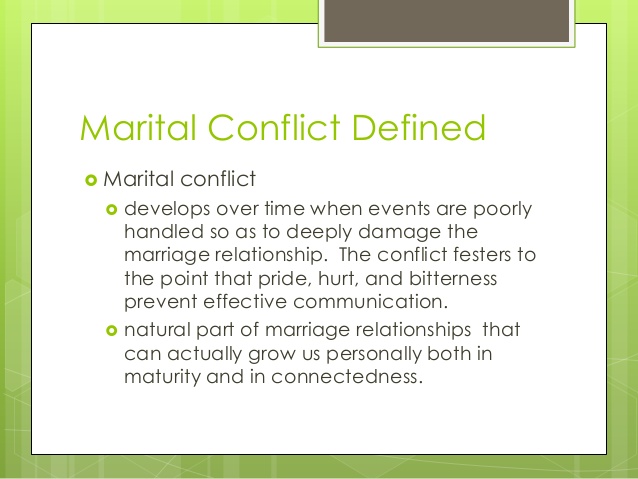
It is important for couples to understand that conflicts are inevitable, and it is part of the marriage relationship to learn how to deal with the conflicts that come up and work through them, as opposed to giving up. In his book, “Drawing Heaven into Your Marriage,” H. Wallace Goddard (2009) relates, “Research found that 86 percent of those who reported being unhappy in their marriages, but who did not divorce, five years later described their marriage as either “very happy” or “quite happy” (p. 108). The secret then, to happy and successful marriages isn’t avoiding conflicts but learning how to cope with and manage conflicts or problems in effective ways.
Gottman explained that:
All marital conflicts … fall into one of two categories: either they can be resolved, or they are perpetual, which means they will be part of your lives forever in some form or another. Once you are able to identify and define your various disagreements, you’ll be able to customize your coping strategies, depending on which of these two types of conflict you’re having” (p.137).

Perpetual conflicts make up about 69 percent of marital conflicts, and couples who remain together and are happy have learned to deal with these problems with a sense of humor, which keeps the problem from overwhelming their relationship. As Gottman (2015) states,
“Despite what many therapists will tell you, you don’t have to resolve your major marital conflicts for your marriage to thrive . . . . By talking about [the problem]” and “constantly working it out, for the most part good-naturedly” and “avoiding situations that worsen [it], [the couple is] able cope by developing strategies and routines that ease the them” (p.139).

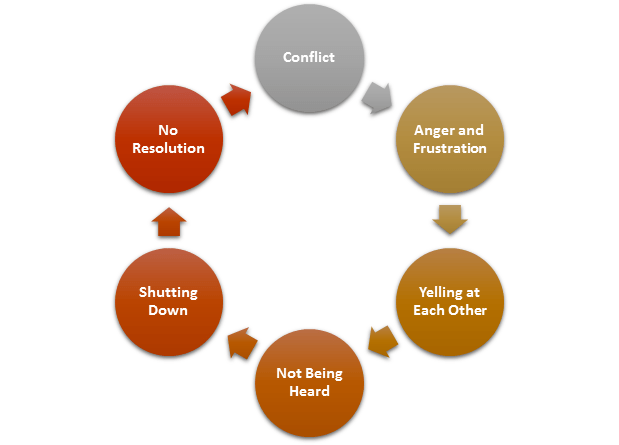
However, in unstable marriages, the couple who rehashes the same conversation over and over again, resolving nothing, and allowing criticism, contempt, defensiveness, and stonewalling to enter into their arguments eventually become gridlocked and makes no headway. Choosing to avoid the conflict leads to emotional disengagement, which results in increased negativity about the other spouse – thoughts that the spouse is selfish and declines in trust — and eventually, parallel lives and possibly the death of the marriage (p.140).

Gottman explains that solvable conflicts are less intense because they are focused on a specific dilemma or situation. His suggested technique for dealing with solvable problems is to tackle them head on, which doesn’t mean that they will be resolved. Gottman cautions that if a couple doesn’t find a way to compromise on the conflict, they can become resentful and entrenched in their positions so that the problem can develop into a gridlocked perpetual problem (p. 142-143). His research into what goes right in conflict resolution resulted in an approach using these steps:
- Soften your start-up (p.161)
- Point your finger at yourself, keeping out any criticism or contempt for your spouse.
- State your responsibility in the situation
- How you feel . . .
- About the specific situation
- What you need (p.165)
- Point your finger at yourself, keeping out any criticism or contempt for your spouse.
- Learn to make and receive repair attempts (p.161).
- Make your attempts obviously formal in order to emphasize them so they aren’t missed (p.175).
- Soothe yourself and each other (p. 161).
- When dealing with flooding, end the discussion for at least 20 minutes to allow your body to calm down, and spend the time doing something soothing (p.181)
- Compromise (p.161).
- In an intimate, loving relationship, it just doesn’t work for either of you to get things all your way, even if you’re convinced that you’re right (p.184).
- Negotiate and find ways to accommodate each other.
- Process any grievances so that they don’t linger (p.161).
- If emotional injuries aren’t addressed, they tend to become constant irritants (p.187)
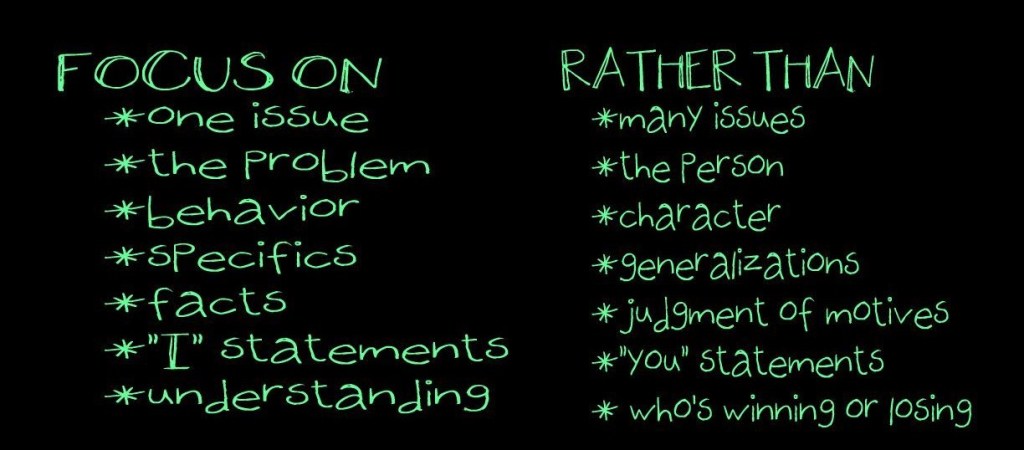
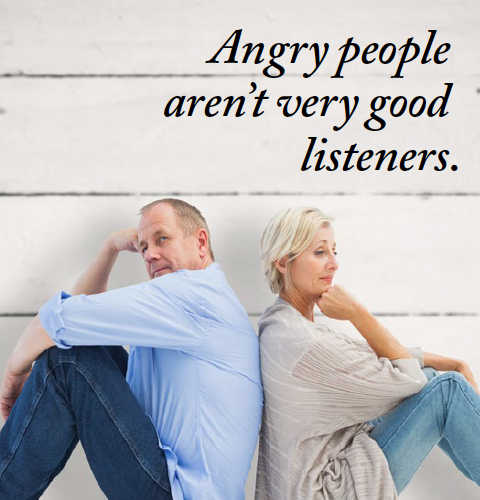
For the most part, you could say that this approach comes down to using good manners. As Gottman explains, “it stands to reason that when a husband and wife respect each other and are open to each other’s point of view, they have a good basis for resolving any differences that arise” (p.160). Additional advice from Gottman for handling marital conflict includes:
- Negative emotions are important. Listen to our spouse’s negative feelings because they hold important information about how to love each other better.
- No one is right. There is no absolute reality in marital conflict, only two subjective ones.
- Acceptance is crucial. It is virtually impossible for people to heed advice unless they believe the other person understands, respects, and accepts them for who they are. Communicate basic acceptance of your partner’s personality.
- Focus on fondness and admiration. Whatever issue is being discussed, give the message that the spouse is loved and accepted for who they are (p.p. 157-159).

In dealing with conflicts we need to remain dedicated to our marriages so our relationships can thrive. Let us remember that most unhappy marriages can be turned around when couples act to manage conflicts in effective ways.

Resources
Goddard, H.W. (2009). Drawing heaven into your marriage. Joymap Publishing
Gottman, J.M., & Silver, N. (2015). The seven principles for making marriage work, 2nd ed. Harmony Books.
 Kirsten's marriage blog