
Within a short time after marrying, most spouses have probably noticed certain “flaws” in his or her spouse. Even before marrying, hints of irritating behaviors may have become apparent, but the spouse figured he or she would get used to them over time—or get the spouse to change. Don’t expect this to happen. It is more likely that the spouse who wants to change their partner is the one who needs to be changed.

Before my husband and I were even engaged, I noticed his tendency for clutter. In fact, when I arrived at his apartment where I met his parents and grandparents for the first time, I looked around his apartment and teasingly commented that I noticed he had rearranged his living room – that the stacks of books that had been in one spot were now in another. His mother overheard my remark, and knowing her son and his habits, she thought it was hilarious. That happened thirty years ago, and my husband retains the same habits. As a known “neat-freak,” this problem could have become a source of constant irritation for me in our marriage. Instead, it has become one of the habits I have learned to accept and live with – peaceably – so it doesn’t become a point of contention in our marriage. How have I done that? Through developing charity.

In his book, “Drawing Heaven into Your marriage,” H. Wallace Goddard (2009) states that “charity is necessary not only for the big challenges but also for the small chafings of daily life” (p. 124). Anyone who has been married has had occasion to feel irritated with their spouse. It is at these times we must make a vital choice. “Will the irritants be the basis for blaming or for compassion? When we react with blame, it usually worsens the condition we hate. We see more faults and feel more irritated. In our own ways we all contribute to our own unhappiness” (Goddard, 2009, p. 118-119). However, when we choose to react with compassion, we are also choosing charity. When we have charity, we learn little by little to see our spouse as the Lord sees them. Marvin J. Ashton, a past apostle for the Church of Jesus Christ of Latter-day Saints (1971-1994), explains the principle of charity well:
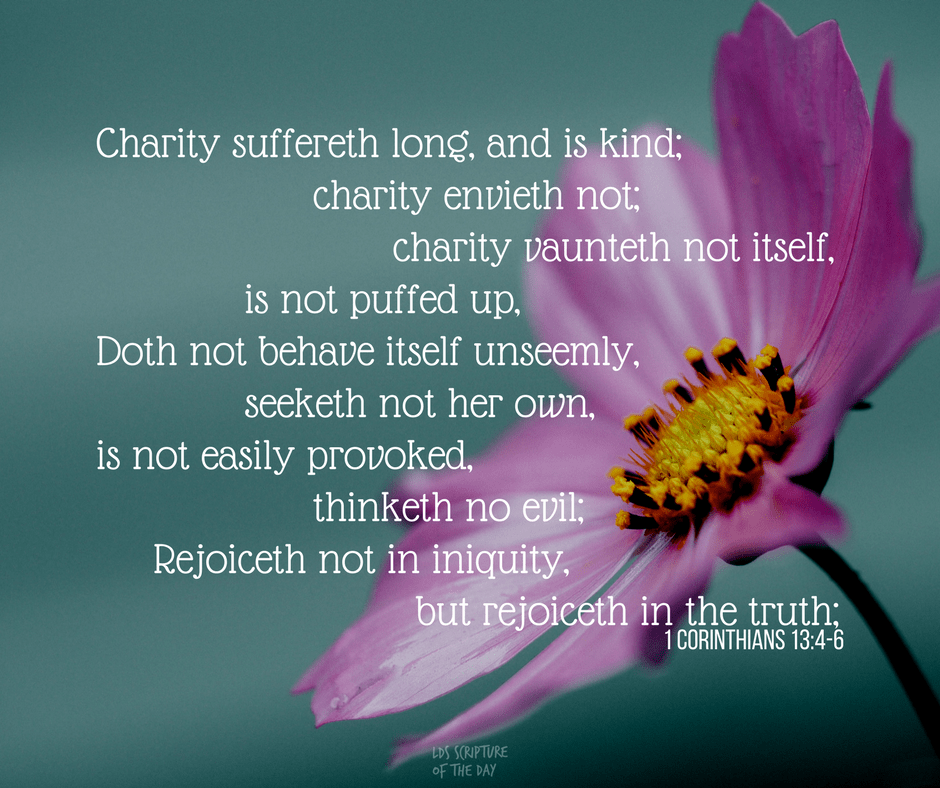
“Perhaps the greatest charity comes when we are kind to one another, when we don’t judge or categorize someone else, when we simply give each other the benefit of the doubt or remain quiet. Charity is accepting someone’s differences, weaknesses, and shortcomings; having patience with someone who has let us down” (Goddard, 2009, p.116).
An important component of exercising charity is choosing on what things about our spouse we will focus our attention. As Goddard (2009) relates,
“At some point in your marriage, like me you have probably enjoyed at least 80% of your spouse’s traits. Even then, there is that bedeviling 20% that still annoys us. Most of our marriage-fixing efforts are focused on that bothersome 20% of our partner’s character that we just can’t find a way to enjoy.
We notice, study, analyze, and organize our lists of our partner’s faults. Then we undertake a deliberate spousal improvement project or–in weak moments—we explode with complaint. Anyone who has objectively observed human nature knows the effect of either cool or hot criticism: it creates discouragement and defensiveness. . . . Criticism does not lead to repentance and growth; it leads to anger, defensiveness and distance” (p. 125).

It goes without saying that most of us prefer our spouse focus on the 80% of the things they like about us. It turns out that doing just that contributes to the happiness of both spouses. Wendy Watson observed, “the best-kept secret in many marriages is the strengths spouses see in each other. . . . An interesting fact about commending your spouse is that the more you do it, the more you see in him or her to commend” (Goddard, 2009, p. 126). Goddard (2009) points out that, “This fits with the research discovery that partners in happy marriages see qualities in their spouses that even the spouses’ best friends don’t see” (p.127).

Goddard (2009) also shared research by John Gottman that of the 20% of things we don’t like about our spouse, about 70% of those things will never change (p.126). This provides us with opportunities for personal growth. As Goddard (2009) explains:

“Rather than re-working our partners to our liking, we are invited to cover their weaknesses with our charity! God is serious about cultivating our charity. Irritations with our partners are not a challenge to diplomacy as much as to our charity. There are no right words when our hearts are wrong” (p.126).
“We need more than a set of skills for expressing discontent and requesting changes. We need a change of heart. The only way to build a truly healthy marriage is by being a truly good person—to be changed in our very natures” (p. 133).
In regards to the 30% of things that we don’t like that can change, Gottman’s research supports that the only way to get partners to change is by not caring if they change, by accepting them the way they are (Goddard, 2009, p. 126-127). This reflects a change in our natures.

And how do we change our natures to develop charity? We must be humble to recognize our own failings. We must have faith unto repentance, trusting in Jesus enough to take our sins to Him and ask for help in managing our actions and changing our natures (Goddard, 2009, P. 127). In other words, we need to develop charity. It is Goddard’s conclusion that “the great mass of quiet-desperation marriages do not need divorce but need only more charity in order to flourish. The Gospel of Jesus Christ is the cure for the common marital complaint” (p.141).

Goddard (2009) relates that through his own “decades of episodic analyzing and blaming, [he] discovered that [his] feelings about [his wife were] not as much a measure of her as of [himself]. Just as our feelings about God are a good measure of our faith, so are our feelings about our companions a reliable gauge to our personal goodness” (p. 141).
As I learned for myself, the problem wasn’t my spouse having a habit I didn’t like and preferred not to live with, the problem was that I needed to change my own heart to love and accept him, habit and all. How can we say we love our spouse completely if we dislike or harbor resentment about something about them? The flaw we see in a spouse should act as a catalyst for correcting a flaw in ourselves. The change needs to take place within us, we need to develop charity. As Goddard (2009) states, “So the messages of research and the gospel are the same: We should enjoy and appreciate our partners. We should forgive them of their humanness. The single most promising marriage-fixing effort is not tinkering with our partner’s characters; it is in loving, cherishing, and appreciating them!” (p. 127). When we change our own natures, when we develop charity, we can love our spouse completely, just like God loves our spouse. This is because “charity never faileth” (1 Corinthians 13:8).


Resource
Goddard, H.W. (2009). Drawing heaven into your marriage. Joymap Publishing.
 Kirsten's marriage blog